
LZC Summer Updates July 2026

Director's Note
America250. How many of you struggled, like I did, to reconcile conflicting feelings this July 4th? Mine included hope, connectedness, patriotism (re-defined, see below), shame, dissonance, disgust, incredulity, curiosity, surprise, and more. Whenever I feel conflicted, I read. So, I’ll kick off our summer newsletter by lifting up a few themes and insights that stood out from my recent readings of historical notes and reflections on the United States at this moment of time, and how it all connects to our work here at LZC to advance immigrant health and well-being:
- Selecting 1776 as a “birth” day and celebrating that day 250 years later is simultaneously a celebration of democratic ideals and an act of erasure. It obscures native, Black, and immigrant histories in service of a whitewashed view of colonization and supports a story of manifest destiny. I spent some time this weekend with one of these recovered stories–poring over a map of the Wabenaki homelandsand learning about Margaret Moxa, a Penobscot womanwho was brutally murdered in the Owl’s Head Bay Massacre in 1755 by state-sanctioned militiamen in what is now Maine, not far from where my family spends time each summer (see Owl’s Head Bay Massacre and Storymap, the Wabenaki Alliance, and the film Bounty for more context). The local “birth” story of New England has more to do with trading and diplomacy and vibrant local economies and thriving cultures (long before 1776) that were usurped by European immigrants through the rise of industry, dehumanization, religious and cultural oppression, labor and sexual exploitation of native people and enslaved people from Africa and the Caribbean, and control of land and natural resources. I cannot celebrate the beauty of our region and the benefits of modern institutions, crops, roads, and technologies without seeing the contributions of native, Black, and immigrant people going back many centuries and continuing on through the current day.
- Last week, Representative Ayanna Pressley (D-MA) read Frederick Douglass’ 1852 speech “What to the Slave is the Fourth of July?” for the first time ever on the floor of the U.S. House of Representatives. The speech makes it clear that the extent to which we are able to rejoice or mourn on this day depends greatly on the degree to which the promises of liberty and equality from the Declaration of Independence have been fulfilled for us and our families. It highlights the violence and oppression that are part of the foundation of this nation–what Viet Thanh Nguyen calls“250 Years of Cruelty”–and reminds us that “revolution” in 1776 meant a break from the rules of feudalism and monarchy. The revolution birthed a new political ideology (an experiment) and created a new system of stratification that has led to the obscene levels of racial and economic inequality we see in the United States today. It meant independence from Great Britain, not freedom for all.
- The United States continues to vacillate on this idea of “all.” The promises of freedom and democracy remain precarious or unfulfilled for so many immigrants, native communities, and communities of color in the United States today. We are rejoicing in the Supreme Court’s decisionto uphold the 14th Amendment and retain birthright citizenship. This means that all people born in the United States are citizens (including Team USA soccer star Folarin Balogun, born to a mother of Nigerian descent, and original birthright citizenship plaintiff Wong Kim Ark, born to a mother of Chinese descent who was denied re-entry to the United States under the Chinese Exclusion Act). We are simultaneously mourning the ongoing attempts to terminate Temporary Protected Status (TPS) for Haitians, Syrians, and other communities (to learn more and/or support the over 45,000 Haitian TPS holders in Massachusetts, see the New American Association of Massachusetts’ statement, the Immigrant Family Services Institute (IFSI)’s emergency response fund, and MIRA’s page of explanations and resources). We stand with solidarity and compassion with our Haitian and Syrian friends and colleagues; the families of Lorenzo Salgado Araujo in Houston, TX, and Joan Sebastian Guerrero in Biddeford, ME, who were both killed by ICE this past week; and all who continue to be harmed by the inhumane policies of the current administration.
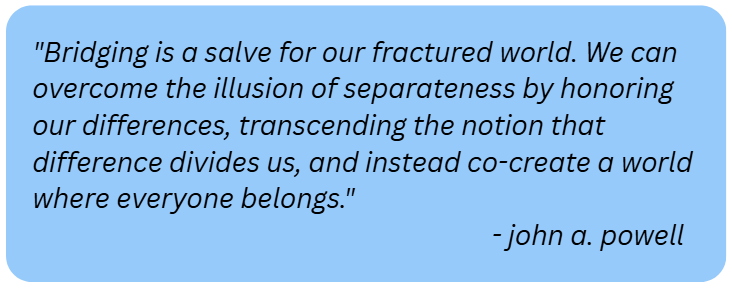
I realized that my own personal version of patriotism is aboutresisting dehumanization and preserving core elements of democracy for all, which is core to our work at LZC. Enjoy the following highlights and updates in research, capacity and learning, and networks. Join us as we celebrate the diversity of this nation and enact john a. powell’s concepts of bridging and belongingthrough our work.
Research Highlights
In this challenging moment, LZC is maintaining an active portfolio of research and evaluation studies focused on translating knowledge into action. Current projects are focused on a wide range of determinants and structures that shape immigrant health, including access to sexual and reproductive care, medical debt, narratives about immigrants in healthcare, parent liberation and child health, and the effects of restrictive immigration policies on immigrant and community well-being.
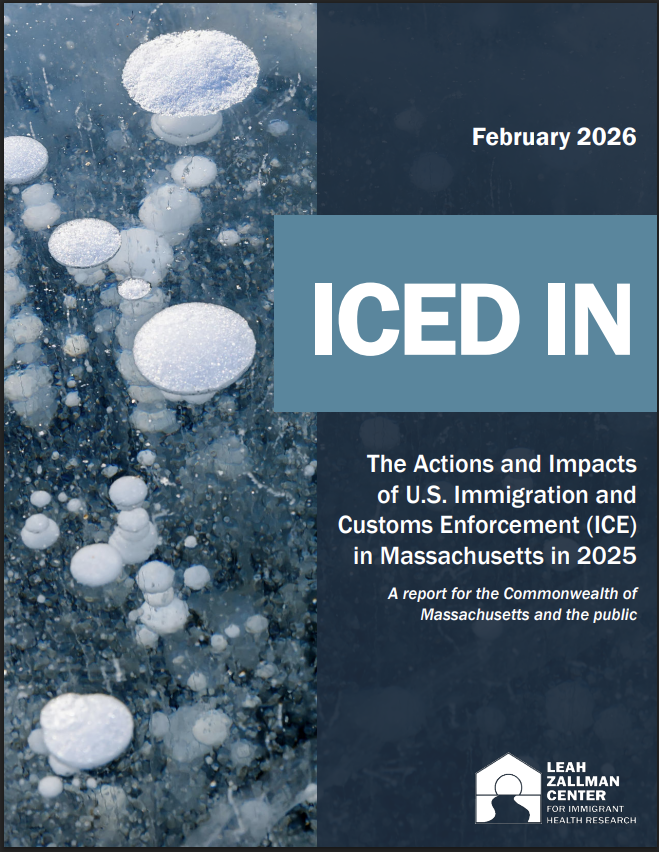
Report and executive summary (in five languages) on the impacts of ICE in Massachusetts
In February, LZC published ICED IN: The Actions and Impacts of U.S. Immigration and Customs Enforcement (ICE) in Massachusetts in 2025. Between March and November 2025, we collected 100 stories from 86 different sources that describe ICE actions and impacts. Through these stories, we found that:
- ICE is arresting non-criminals in the community;
- ICE is using excessive force, violence, and intimidation as a strategy;
- ICE is creating a climate of fear; and
- ICE is suppressing basic rights and support as another strategy.
We also describe the main impacts that ICE actions are having in Massachusetts, including psychological, financial, and health impacts on individuals and families; institutional impacts in healthcare and social services; and community impacts on towns, businesses and schools.
We are actively disseminating this report! We encourage you to visit our websiteto find the full report, the executive summary (which has been translated intoHaitian Creole,Portuguese, Spanish, and Vietnamese), poster, video presentation, and a social media toolkit.
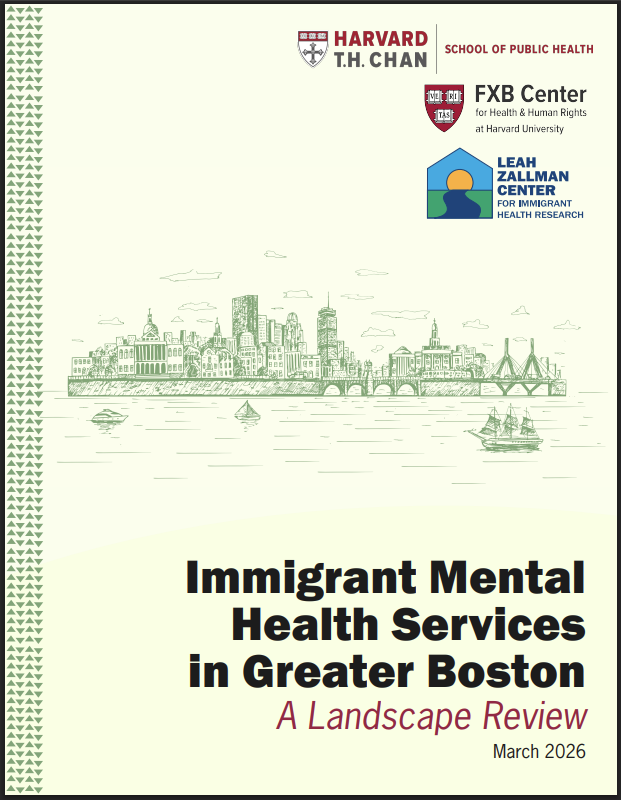
Landscape review of immigrant mental health services in Greater Boston
In partnership with the Harvard T.H. Chan School of Public Health and the FXB Center for Health and Human Rights at Harvard University, LZC is proud to release Immigrant Mental Health Services in Greater Boston: A Landscape Review. This landscape review compiles and categorizes the current landscape of mental health programs and services available in the Greater Boston region in clinical and/or community settings that support and advance immigrant mental health, including innovative models that bridge clinical and community care.
We would like to thank the Harvard Chan team–including our 2025 summer scholars Milka Ashine and Siddiqua Shuma–for all their work and support on this project.
Access the report here.
Capacity and Learning Highlights
Goodbye and good luck
Danielle Chun, MPP, is moving out of state and leaving ICH at the end of August after 4.5 years. Nothing lasts forever, but for those of you who experienced “Jess & Dani” together at LZC or the Heller School at Brandeis, you’ll know that we had a very special stretch for 7+ years. We are grateful for all the foundational work Dani contributed to LZC since day one, and will miss her superior partnership skills, conceptual clarity, precise editing, and sense of humor. Dani shared the following:
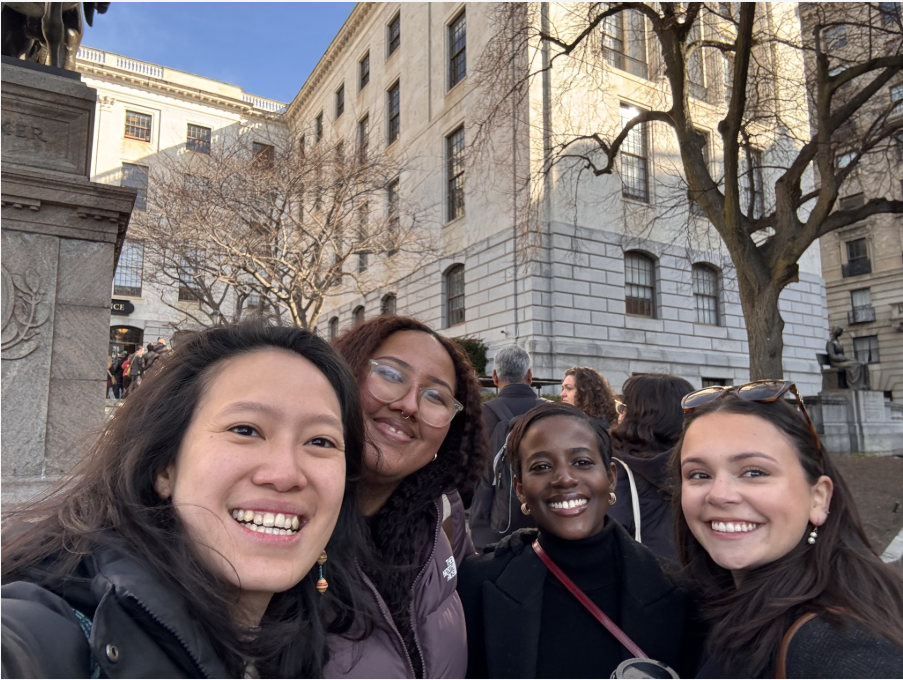
Rolande Ayinkamiye, MA, also departed ICH after 3.5 years at the end of June to move out of state and pursue new opportunities. Rolande also came to ICH from the Heller School at Brandeis, contributing significantly to LZC projects as a Research Associate while here. See her recent reflective blog on shared authorship here. We will miss her calm demeanor, poise and style, and listening skills on our many projects!
Dani and Rolande—Thank you for making LZC what it is. We wish you all the best and know that you will bring the same energy, commitment, and intelligence to your next roles. Stay in touch!
We are working closely with ICH leadership and our other core LZC staff Ariela Braverman Bronstein, MD, PhD, MPH; Sofia Ladner, MPH; and Erika Decklar, MPH to ensure continuity on LZC projects and core operations. We also look forward to opening up opportunities for more ICH staff to lead and become involved in LZC work over time.
Learning across TA projects
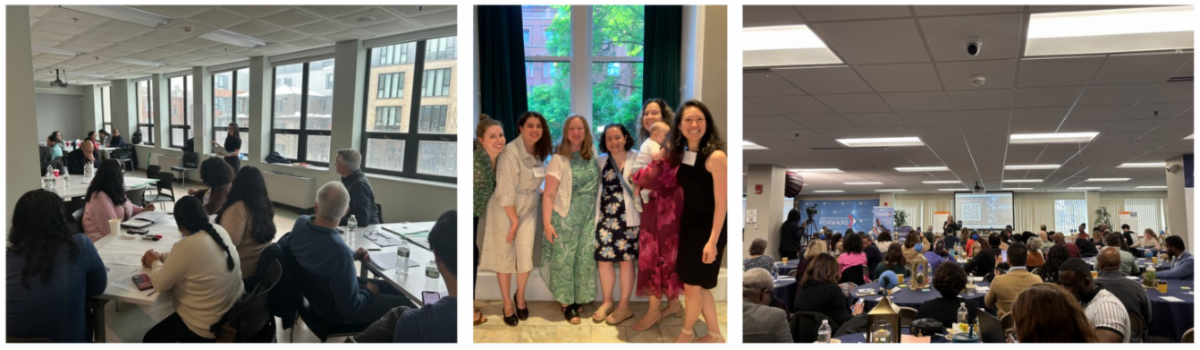
LZC’s portfolio of technical assistance (TA) work is going strong! We have longstanding evaluation and TA partnerships with the City of Boston Mayor’s Office for Immigrant Advancement (MOIA), the Massachusetts Immigrant Collaborative (MIC), Vital CxNs, and the Massachusetts Immigrant and Refugee Advocacy (MIRA) Coalition, among others. Reach out if you are seeking technical assistance support around evaluation or research as you build capacity and impact in organizations supporting immigrants and refugees.
Networks: LZC in Community
Recent Coffee Chats
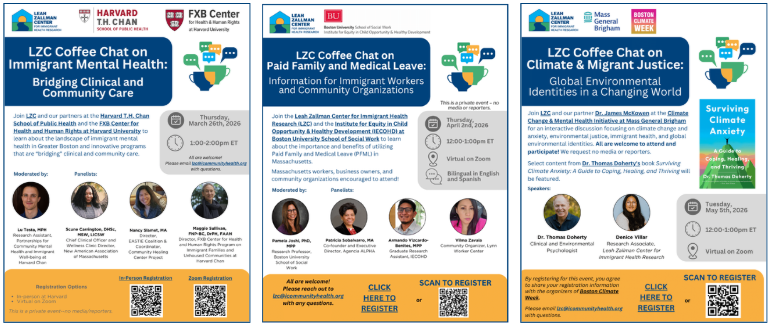
LZC hosted three Coffee Chats this past spring, including an in-person Coffee Chat at the Harvard T.H. Chan School of Public Health on Immigrant Mental Health: Bridging Clinical and Community Care on March 26, a virtual Coffee Chat with Boston University scholar Dr. Pamela Joshi from the Institute for Equity in Child Opportunity and Healthy Developmenton Paid Family and Medical Leave on April 2, and a virtual Coffee Chat withDr. Thomas Doherty, author of Surviving Climate Anxiety, on Climate & Migrant Justice: Global Environmental Identities in a Changing World on May 5.
LZC Coffee Chats are designed to highlight specific topics, research findings, and partners and to foster dialogue about immigrant health and well-being. Stay tuned for upcoming events in Fall 2026!
Conferences, webinars, and partner events
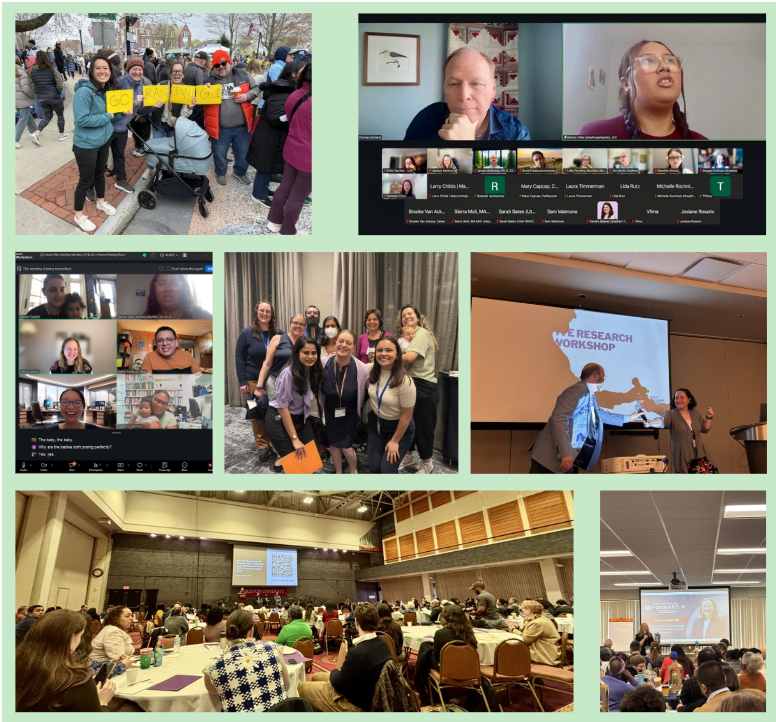
LZC was thrilled to have a research oral abstract for our Policy on the Frontlines study accepted at the International Refugee and Migration Health Conference (IRMHC) in San Diego, CA last month! Dr. Ariela Braverman Bronstein, LZC Health and Equity Research Advisor and study co-principal investigator, and Danielle Chun, LZC Strategy and Partnerships Manager and study project manager, attended and presented on our research to date.
Ariela and Dani also conducted two workshops on quantitative methods and evaluation as part of IRMHC’s new Research Methodology Workshop Series, and Dani co-led another workshop on immigrant mental health with partners at the FXB Center for Health and Human Rights at Harvard University, the Haitian Mental Health Network, and the Community Healing Center Project / EASTIE Coalition.
It was an amazing time building connections with researchers, healthcare providers, advocates, and community leaders at the conference; feeling inspired by the good work that’s being done all over the country and world; and remembering how and why we do this work.
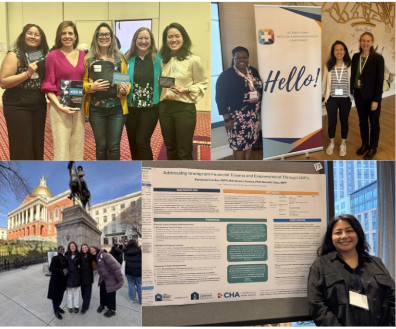
The LZC team also attended and presented at several other conferences, webinars, and other community partner events. Highlights include:
- Co-hosting a Health and Law Immigrant Solidarity Network webinar
- Jessica Santos’ presentation on ICED IN at MIRA Coalition’s Spring Into Action Conference and the Immigrant Family Services Institute (IFSI) Symposium
- Danielle Chun’s presentation at a Drexel University symposium
- Attendance at Immigrants’ Day at the State House
- Poster presentation at the Cambridge Health Alliance (CHA) Academic Poster Session
- Attendance at the Julian Bond Institute Research Advisory Council in Washington, D.C.
Updates from the Institute for Community Health
LZC is a center at the Institute for Community Health (ICH). Through participatory evaluation, applied research, and other services, ICH staff work with local and national partners to improve community health in a sustainable and equitable manner. ICH is supporting state and local governments, health care systems, and community-based organizations that strive to make health and wellbeing accessible to everyone. Visitour website to learn more about the work that we do and check out our latestblog posts and publications.
Support and engage with the Leah Zallman Center for Immigrant Health Research
The work of the Leah Zallman Center for Immigrant Health Research is made possible by generous private donations that support our unique and intensive model of community-engaged, participatory research. We are grateful for our monthly and special donors who enable us to support the perspectives and knowledge of immigrants and grow future leaders. We invite you to join us on our mission by donatinghereand share this newsletter with others who support immigrant health and invite them to join our listserv here.