New American Cities

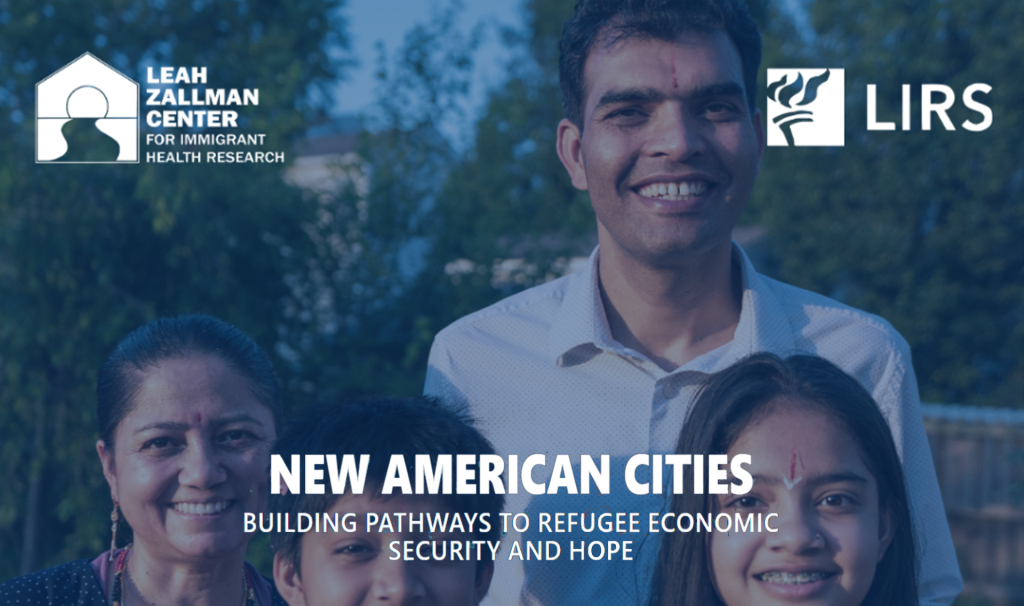
The Leah Zallman Center for Immigrant Health Research (LZC) at the Institute for Community Health and Lutheran Immigration and Refugee Service (LIRS) are proud to jointly release New American Cities: Building Pathways to Refugee Economic Security and Hope. The report shares findings from a two-year study of LIRS' flagship New American Cities (NAC) program, a workforce development initiative focused on moving refugee and immigrant workers into family-sustaining jobs so that they can achieve economic self-sufficiency and career advancement. Findings show that New American Cities boosted refugees’ career trajectories, economic security, and hope, creating more prosperous communities. Many refugees and immigrants bring a wealth of education and job skills with them to United States but tend to be underemployed due to refugee employment programs that have historically lacked the resources and infrastructure to provide career advancement opportunities. In 2021, LIRS sought to address this issue by launching a two-year pilot program to enhance collaboration between local governments, workforce centers, employers, and resettlement agencies. New American Cities filled a gap; approximately 60% of those who completed the program secured new jobs or advanced in their careers. Of those who entered the New American Cities unemployed, job placements resulted in average hourly wages of $19.63. Those who entered employed but were making less than the federal poverty line, saw their average hourly wages increase by 41%, from $13.56 to $19.08. Finally, those who entered the program earning more than the federal poverty line saw average hourly wages increase by 19%, from $19.84 to $23.53. The report also provides a community-level portrait of program sites in Baltimore, MD; Denver, CO; Fayetteville, AR; Jacksonville, FL; and Utica, NY; outlines components of the program’s model that add value to workforce programs and cities; and calculates New American Cities’ return on investment to participants and communities. On average, participant tax contributions after one year equal $6,700 per person more than they would have without the program. Over 10 years, assuming standard cost of living adjustment increases, the average tax contributions going back to the city equal $86,706 per program participant. Read and download the executive summary or the full report.
Healthcare Training Tracking: A Key Intervention Point to Improve Racial Equity in the Healthcare Workforce

Researchers at Brandeis University's Institute for Economic and Racial Equity (IERE), including Dr. Jessica Santos, LZC director and visiting scholar at Brandeis, have released a new report entitled Healthcare Training Tracking: A Key Intervention Point to Improve Racial Equity in the Healthcare Workforce. This new report builds on nearly a decade of research on HPOG programs. Findings include that Black participants enter lower-level training programs than their white counterparts with the same educational background, contributing significantly to the racial wage gap. By intentionally guiding Black men and women to training programs with better outcomes, similar to those taken by White HPOG participants, workforce training centers could begin to tackle the problem of wage and opportunity disparities in healthcare.

Measuring Well-being

Measuring Well-being is a reference list for researchers and organizations wishing to measure the impact of mental health and well-being interventions for immigrant populations. Developed as a companion resource to Weaving Well-being, Measuring Well-being offers a snapshot of selected validated scales within the domains of Discrimination Racism); Resilience; Stress, Anxiety, and Depression; Trauma; Well-being; and the COVID-19 Pandemic. This publication was jointly released by LZC and the Addressing Disparities in Asian Populations through Translational research (ADAPT) Coalition.

Weaving Well-being: A New Paradigm for Community Mental Health and Wellness: Executive Summary

Immigrant families in Boston faced significant challenges during the past two-and-a-half years of COVID-19 and engaged in many different collective forms of care, healing, and advocacy. In April 2022, MOIA awarded a total of $70,000 in a six-month pilot program to seven organizations to support community-driven efforts to improve immigrant mental health. This report presents the findings from LZC’s participatory assessment of this mini grants initiative, including key design features from the seven pilot initiatives that could be incorporated into future immigrant mental health programming. We present qualitative and quantitative outcomes related to social integration and cohesion, and resilience and well-being. We end by making recommendations for future multi-sector actions to advance immigrant mental health and well-being, drawing on a new paradigm for community mental health and wellness.

Immigrants contributed $25.1B more to private insurance than they took out in 2014

Finnegan KE, Touw S, Himmelstein D, Woolhandler S, Zallman L. Immigrants contributed $25.1B more to private insurance than they took out in 2014. Oral presentation at Academy Health Annual Research Meeting; 2018 June 24-26; Seattle, WA.

ED visits and spending by unauthorized immigrants compared with legal immigrants and US natives.

Stimpson JP, Wilson FA, Zallman L. Am J Emerg Med. 2014 Jun;32(6):679-80. Epub 2014 Mar 19.